When Sinners and One Battle After Another both raked it in at the box office last year, I started to wonder whether the tyranny of sequels, prequels, and franchises had finally started to loosen its grip on audiences. Is that why Prime Video’s Young Sherlock isn’t being advertised as a prequel to Guy Ritchie’s 2009 movie Sherlock Holmes, despite sharing the same look and tone, while also being developed, executive produced, and partially directed by Ritchie?
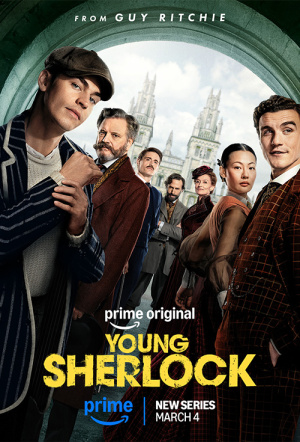

I feel like I’m being gaslit here. Young Sherlock is, supposedly, an adaptation of Andrew Lane’s series of YA novels, formally authorised by the estate of Arthur Conan Doyle, which follow a precocious 14-year-old iteration of the great literary detective (Doyle, pointedly, never divulged any details of the character’s upbringing). Here, however, Sherlock (Hero Fiennes Tiffin) is a 19-year-old freshly sprung from prison by his older brother Mycroft (Max Irons) and sent to Oxford University not to study, but to labour as a humble scout.
Initially apprehended for pickpocketing (for fun, he claims), Sherlock enjoys fisticuffs just as much as Robert Downey Jr.’s iteration but isn’t yet as adept in the practice. When the arrival of a Chinese princess, Gulun Shou’an (Zine Tseng), results both in the theft of her father’s The Art of War scrolls, and a series of murders targeting academics, Sherlock is fingered by a young Lestrade (Scott Reid) as the primary suspect.
He’ll solve the case not through brain but through brawn—specifically, through explosive chase sequences and shootouts peppered with bullet time flourishes, all soundtracked to raucous renditions of Irish tunes like “Rocky Road to Dublin” and “Devil’s Dance Floor”. In one scene, Sherlock puts on a flat cap and, practically to camera, declares, “the game’s afoot”, while we’re presented with stock Ritchie characters like the aristocrat who pontificates on the glory of avarice and the thinly sketched badass woman.
It’s near-impossible to differentiate Young Sherlock from Ritchie’s (older) Sherlock Holmes. So what, then, is the point of any of this, if we aren’t meant to consider this a prequel, but a brand new story that feels exactly like the old one? Could it be that franchises won’t retreat, but merely disguise themselves? Any comparison certainly doesn’t serve Young Sherlock well.

For its premiere mystery, it’s taken the obvious route; here’s yet another detective show where it gets personal for our protagonist, forcing us to dredge through the Holmes family trauma. We meet his institutionalised mother (Natascha McElhone) and absent father (Joseph Fiennes), and learn of how they came to be that way, after the tragic death of their daughter.
But we don’t learn what effect it’s had on Sherlock himself, beyond the occasional bad dream. He’s a fairly chipper gent, subject only to the occasional bout of melancholy. Fiennes Tiffin fails to colour in the outline much. And, while he’s introduced to us as the loner “black sheep” of his family, he has a suspiciously easy time making friends when he first lands in Oxford.

One of them we’re already intimate with: not Watson but the other option, Sherlock’s future nemesis James Moriarty (Dónal Finn), meaning we’re instantly put on the track of friends-to-enemies. Only Moriarty never feels spiritually at odds enough with Sherlock to ignite much of a spark, outside of the occasional suggestion they do something illegal followed with a quick, “haha, of course I was only JOKING. I’d NEVER commit a crime.” Wink wink.
That Moriarty will eventually betray Sherlock is an act I’m sure Ritchie will build up to in future seasons. If there’s a way Young Sherlock can figure out how to do that without feeling like we’re sprinting over the same set of hot coals over and over again—well, I’d be eager to see it.