When we crave nostalgia, it’s not really for the films, the songs, or the shows themselves, is it? It’s grief over the passage of time, the loss of the younger, happier, more innocent selves that we can now only view from the rearview mirror. It’s a bone-rooted desire to somehow, even if it’s an illusion, go back to that time.
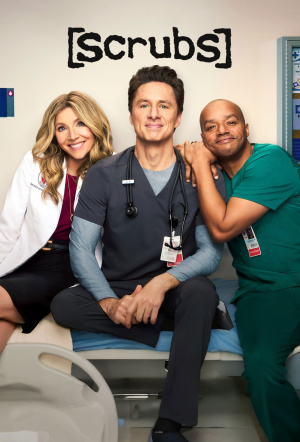

Yes, the prominence of “nostalgic” art is, in part, because familiarity is an easy way to lure audiences. It’s a symptom of our risk-averse economy. But, as I dipped my toes back into the world of Scrubs—now revived with its original cast, original location, original theme, and original format—I was struck by how much the endeavour seemed laser-focused on pursuing a cryogenically frozen sense of time.
Having said that, when we first recounter medical doctor J.D. (Zach Braff), he’s working as a concierge doctor, making house calls for the upper crust. But barely a beat passes before we’ve magically returned to the old norm. J.D. and surgeon Turk (Donald Faison) are besties attached at the hip, at one point hanging out in matching pyjamas, while their love interests Carla (Judy Reyes) and Elliott (Sarah Chalke) lovingly roll their eyes, arms most likely crossed.
New Scrubs, I think you could argue, is just about as good as old Scrubs, but it’s so singularly obsessed with feeling like old Scrubs that it’s as if everyone on the writing staff felt too afraid to make a single cultural reference dated to post-2010. We get nods, then, to Pixar’s Up and The Notebook, releaed in 2009 and 2004 respectively. If you uttered the words K-Pop Demon Hunters around these characters, smoke would start coming out of their ears. Don’t break the simulation! We exist purely at a point in history where hope is an emotion that can still be felt and processed by the human body!
What effort there is to acknowledge that time has passed comes in a new batch of medical students for our central quartet to mentor (a similar setup was already attempted with the poorly received ninth season, featuring Dave Franco). Asher (Jacob Dudman) is British and scared of needles. Serena (Ava Bunn) is an influencer.

The shallowness of those archetypes mellows out as the season goes on, but there are still a little too many unfunny gags to sift through here, about how Gen Z are all weak and self-obsessed. I’ve come to regard it as a pretty surefire sign a project is floundering when they wheel out former SNL star Vanessa Bryant, a talented performer who’s much, much better than most of the the material she’s been given. Here, she plays a new HR exec whose sole job is to tell the oldies to “tone it down” when they start calling the trainees “fragile little Christmas ornaments.”
Other attempts to incorporate cultural relevance, including a deeply noncommittal nod to healthcare inequality and a one-episode arc about orthorexia, feel almost at odds with the otherwise insular world of Sacred Heart. It’s a strange result: a series that successfully hits the same tone and all the same emotional beats as its predecessor, yet in doing so feels so immediately out of place that the entire experience is mildly disconcerting.
Yes, I’m sure lots of us wish it were 2007 again, but will it really soothe the loss to so forcefully play pretend like this?