Two big movies opened in Australian and New Zealand cinemas at the end of January: Send Help, the great Sam Raimi’s first original horror movie since 2009’s Drag Me to Hell, and It Was Just an Accident, lauded auteur Jafar Panahi’s Palme d’Or-winning thriller freshly nominated for Best International Film and Best Original Screenplay at this year’s Oscars.
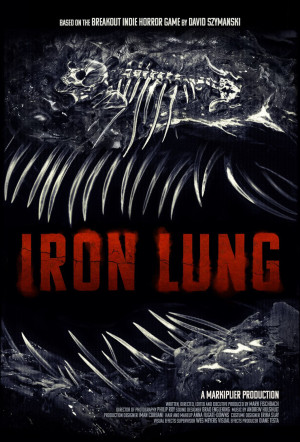
Which one topped the AU and NZ box office over the weekend? Neither. It was Iron Lung, an independent chamber horror you’ve either never heard of, or have constantly heard about for years.
For the clueless, Iron Lung is the feature writing-directing debut of Mark Fischbach, a YouTuber currently sitting on a whopping 38 million subscribers. Based on the 2022 game by David Szymanski, the story takes place in a mostly doomed universe. The stars are gone. Most of humanity’s dead. Whatever hope’s left lies deep in an ocean of blood on a desolate moon—and a convict (played by Fischbach) must man a decaying submarine through this viscous unknown with little more than numbers, a pencil, a paper map, and an x-ray photo camera as his only means of seeing what’s outside the sub.

As far as feature debuts go, it’s a novel and crafty property to adapt. The confined setting of the game translates well into a chamber film, the claustrophobic environment and purposeful removal of key senses recalling the panic-soaked tension in undervalued Ryan Reynolds thriller Buried and emergency phone line nail-biter The Guilty.
But just because it’s self-financed and set in one location doesn’t mean it feels cheap. The production indulged in an Olympic pool of fake blood (which really shows itself in the film’s dying minutes) and video of the hydraulics-bound set is a thing to behold.


This Markiplier Iron Lung YouTube playlist gives a pretty good snapshot of the film’s journey, from Fischbach’s first playthrough of the game to the teasers and trailers for the film and his giddy/teary gratitude for the film’s box office success.
Mobilising a deeply engage following, Fischbach drove a self-release strategy which torpedoed the humble $3 million USD budgeted film into 4000+ screens worldwide. In its opening weekend, it snagged over $20 million USD in the States and more than $2 million in Australasia (distributed by Rialto Distribution).

Iron Lung also bears a lot of common push-n-pull qualities of an independent first-time filmmaker: too many ideas rub against the elegant setup, the pace wobbles between satisfying slow-burn and chain-dragging lurch, and the overused psychological aspect of the story borders on needless and cliched.
A Hollywood studio experienced in feature filmmaking probably would have highlighted all these shortcomings. They would have also told Fischbach not to adapt Iron Lung. Count us lucky he made the movie he wanted on his own terms, flaws and all.
Given the gargantuan success of The Super Mario Bros. Movie, Five Nights at Freddy’s, and A Minecraft Movie, Hollywood sees the dollar signs on videogame adaptations. But those are massive games with numerous titles, characters, spinoffs, lore, and fan bases attached to their reputation. It’s a punishing task to refine all that into a feature-length film that also ticks the “I recognise that” box seemingly every suit and focus group demands.


By comparison, Szymanski’s game is blissfully straightforward. The grimy Quake-like aesthetic perfectly plays to the grubby world, there isn’t much to the gameplay beyond basic button presses, and you can punch the whole thing out in less than an hour. By choosing to adapt such a succinct experience, Fischbach gives his film room to breathe (too much room, perhaps) and expand the atmosphere as opposed to blasting through a beloved videogame environment like a bullet train through Disneyland.
Sadly, I don’t think studios will look at Iron Lung and reconsider which games will make more sense to adapt into movies. I think they’re more likely to see Markiplier’s self-initiated success as a big rethink of film distribution and a motivator to court other YouTubers into filmmaking.

While I shudder at the thought of Jake Paul’s Call of Duty opening Tribeca, RackaRacka (Talk to Me, Bring Her Back) film critic Chris Stuckmann (Shelby Oaks) have already proven how seasoned YouTubers can transfer their skillsets over to filmmaking. But will studios open the filmmaking doors for YouTubers based on their talents as writers, performers, editors, and directors or their follower count?
Fortunately, Markiplier shows considerable filmmaking promise with his debut feature and fully understands the importance of the simple but effective little horror game that kicked off this whole journey. One can only imagine how David Szymanski feels seeing his name as the first credit displayed massively and proudly at the end of a box office-topping movie.