To put it technically, a pillion refers to the passenger and/or passenger’s seat on the back of a motorcycle. But in a very specific subculture, a pillion refers to the submissive in a dom-sub relationship. It’s also the name of a great film that explores the kink with an ironically gentle touch.
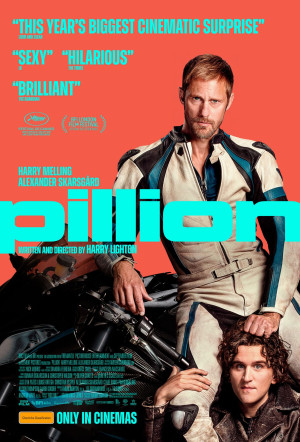


Adapting the novel Box Hill by Adam Mars-Jones, writer-director Harry Lighton’s Pillion centres his film on Harry Melling’s Colin – a very good boy with puppy dog eyes who would like nothing more than to be someone’s little bitch. His wish comes true when he meets impossibly handsome biker Ray played by Alexander Skarsgård whose stoic demeaner and sigma physicality isn’t a million miles away from his Viking prince in Robert Eggers’ The Northman.

Their first “intimate” meeting sees Colin being forced on his knees and told to lick Ray’s dirty boots before taking his mouth elsewhere. It can sound menacing on paper, but Melling smoothly shows how his character’s super into this. Through Colin’s bright-eyed enthusiasm, the audience becomes pillions themselves to the film’s authentic ride through the intersection of kink and love.
Like a lot of film nerds my age, my first exposure to BDSM culture came from Quentin Tarantino’s Pulp Fiction. Not to retroactively shame a single film (a masterpiece, no less) for broader society’s ignorance, but the image of a gimp in a trunk “owned” by a pair of rapists didn’t do the queer kink community any favours.


Pillion, however, went out its way to truly understand the culture it’s putting on screen. Speaking to GQ about his ride-along with an actual Gay Bikers’ Motorcycle Club, Lighton said: “It was important to me that anyone from the [BDSM] community would watch the film, and [recognise] the details involved… ‘I can see that they’ve done the work, and I’m not being pulled out of the film by a surface approach to BDSM.'”

While the GBMCC isn’t a kink or fetish club, numerous members are part of that culture. As well as casting those bikers and pillions in the film, whose affectionate existence act as a clever contrast to the gaping flaws in Colin and Ray’s partnership, Lighton also interviewed dom-sub couples to get a fuller understanding of their parameters to help define his fictional couple’s relationship.
We didn’t see any nuance a decade ago when the world lost its collective minds over Fifty Shades of Grey. The adaptation of EL James’s infamous novel may appear to be into the same kinks, but the power dynamics are completely different. While Colin is enthusiastically keen to become a submissive to big dog Ray, Dakota Johnson’s Anastasia needs to be ruthlessly convinced by Jamie Dornan’s mega-wealthy and creepily obsessive Christian Grey. Given how care and safety are prime pillars of BDSM, the careless and unsafe treatment of the naïve Anastasia in the manipulative hands of Christian made Fifty Shades of Grey a poor and exploitive example of the culture.

Pillion, however, provides astutely observed scenes of a blank Ray wrestling an overjoyed Colin into submission, paired with moments of Colin left alone to run errands while Ray’s washing his bike. We aren’t told what the characters are thinking, but the dissonance is clear: Colin’s here for the physical dominance, not the neglect or emotional abuse.

While we never question Colin’s physical safety, Ray’s care – or apparent lack of it – goes under the microscope, and makes Pillion far more complex than many will expect. His macho mascaraed may make for an exciting front on the fetish side of things, but at their relationship goes on, the seemingly impenetrable shallowness of Ray’s propped-up persona challenges Colin’s self-worth and deeper desires. The one fleeting moment Ray lets the mask slip tells you everything you need to know – and makes you feel everything that needs to be felt.
That moment recalls Peter Strickland’s excellent 2014 film The Duke of Burgundy, which treaded similar ground but with inverse power dynamics. The story centres on Cynthia (Sidse Babett Knudsen), the dominant mistress to Evelyn (Chiara D’Anna), and her growing struggles to keep up with the mounting desires of her much younger and more energetic submissive. If you didn’t know The Duke of Burgundy was an arthouse film, you will by the time it hits its apex: a psychological doozy of a head trip that visually swirls with emotional heft and angst.

Pillion, meanwhile, is a lot more mainstream, hitting familiar romance beats and smoothing everything over with a winningly light sense of humour. But to thinly call it a rom-com would sell the film short – its complex, affecting, genre-ascending conclusion will chain itself to you.