Patricia Cornwell based Kay Scarpetta, the lead of 29 of her crime novels, on a true-life pioneer: Dr Marcella Farinelli Fierro, who was the ninth woman in US history to be board-certified in forensic pathology. In 1994, she took up the position of chief medical examiner for the state of Virginia, playing a crucial role in the country’s first conviction of capital murder using DNA evidence.

Fierro retired in 2008. And while Hollywood struggled to put Scarpetta on screen – even as she attracted the interest of Demi Moore, Angelina Jolie, Helen Mirren and Jodie Foster – the number of US women certified in forensic pathology grew to 350.
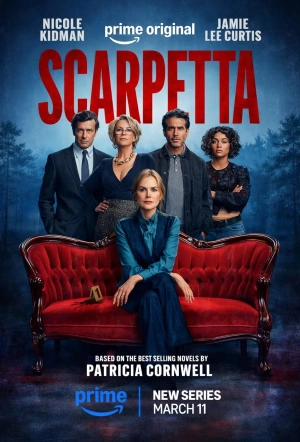
So what should Dr Scarpetta do in 2026, now that she’s finally arrived on the small screen, played in the present day by Nicole Kidman and in flashbacks by Rosy McEwen? To find out, we can consult creator Liz Sarnoff’s new series – an easily bingeable, high-speed collision of tones and ideas that’s frequently confounding but rarely dull.
Its eight episodes fuse together two of Cornwell’s novels, Postmortem and Autopsy, in order to intimately connect their cases. In the first, set in 1998, where she’s played by McEwen, a young Scarpetta tracks down the killer of five women, cementing her newly appointed status as the chief medical examiner of Virginia. In the second, set in the present day, where she’s played by Kidman, a pair of murders suddenly call into question her previous expertise. Could she have gotten the wrong man convicted?
McEwen and Kidman have communicated beautifully with each other. Kidman has a natural acuity in her eyes that projects outward like a lighthouse beam, making her a good choice to play this kind of highly logical and emotionally detached mind. McEwen, in turn, adopts the same approach, feeling like the same character without the pageantry of celebrity imitation.
Scarpetta is a woman moulded by violence, a witness to her father’s murder at a young age, whose life’s work fuels the desire both to do good and to desensitise herself from her own trauma. It’s an idea extended into how the series depicts its brutalised victims (frequently, graphically and without hesitation), and in the way Scarpetta’s autopsies are shot with elegant precision, as ribcages are cracked open in split screen while a classical cello keens over the score.
Scarpetta, in the present, is trapped in a familial hamster cage. She lives with her concerningly disengaged husband, Benton Wesley (Simon Baker); her sister Dorothy (Jamie Lee Curtis), who has never internalised an emotion in her life; Dorothy’s husband and Scarpetta’s trusty sidekick, Pete Marino (Bobby Cannavale); and Dorothy’s daughter Lucy (Ariana DeBose), who spends all her time talking to her dead AI wife (Janet Montgomery).

No one in this little pen acts like a human. It’s no surprise, then, that they all get on swimmingly with the algorithm designed to mimic a deceased person. When Dorothy visits her sister and husband at work, she runs screaming through the halls of the coroner’s office, evading bones and stripped flesh like she’s in a Scooby-Doo cartoon.
At one point, Kidman’s Scarpetta takes a baseball bat to someone’s cremated skeleton in a way that I personally would not like to happen to my dead body. In another, McEwen’s Scarpetta blackmails her employers and then walks out for a cigarette to the beat of Nancy Sinatra’s “These Boots Are Made for Walkin’”.
If these scenes count as “camp”, then they come at the cost of any wider point about misogyny and morbidity. But in the time that’s elapsed since her creation, Scarpetta herself has become less of a radical figure by nature. We’ve seen the female pathologist fighting the system before. What we haven’t seen before is a crime show with a homicide in space, Russian espionage and 3D-printed organs. You certainly couldn’t call it formulaic.