Stand-up comedians are just people with problems, who have access to a microphone. This wasn’t the only message I took from Bradley Cooper’s new film as a director, Is This Thing On?, though it’s very much in keeping with its worldview, viewing comedy as catharsis: a very public, very drink and people-filled confessional.
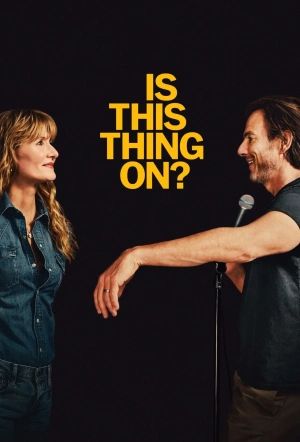


At least this is true for Will Arnett’s protagonist, Alex Novak, who’s experiencing a miserable stretch of his life, in the midst of a separation from his long-time wife Tess (Laura Dern), with whom he has two young boys. The first time we see him—at a school event—his face is slumped against a wall, as if broadcasting to the world that he’s dead on the inside.
The term “MacGuffin” describes a storytelling device—an object, event, or person—that propels a plot forward, setting off a chain of consequential events. In this film—co-written by Cooper, Arnett and Mark Chapell—that moment is unusually understated, scripted as an act of pure spontaneity. In order to avoid paying the door charge to access a Manhattan comedy club, Alex puts his name on the open mic list, and soon finds himself blabbering about his relationship woes to a more or less accommodating audience.
A lesser script might’ve revelled in his heretofore unrecognised greatness: the lightbulb in his head switches on; the audience are blown away by his wit and punchlines; destiny whirs into gear; life will soon be tickety-boo. But this isn’t that kind of film. It’s less prescriptive, and doesn’t take place in a reality filled with smooth edges and certainties. The gig goes just well enough for Alex to get a taste for comedy, and a desire to do it again. He returns, starts refining his act a little, and encounters an encouraging community of comics.
It’s an authentic depiction of artistic motivation that pushes back against the popular, biopic-endorsed view of artists as being touched by the gods, their destinies written in the stars. In this way, Is This Thing On? reminded me of Monsieur Aznavour, last year’s drama about French-Armenian singer-songwriter Charles Aznavour, which took a refreshingly different view of stardom, emphasising hard work and the protagonist’s methodical approach.
It also reminded me of the very differently vibed Marty Supreme, which wasn’t really about table tennis, just as Is This Thing On? isn’t really about comedy. In Marty Supreme, far more important than any sporting outcome is the protagonist’s emotional state. We don’t really care who wins—I wasn’t even sure I liked Marty—but we care (and have no choice but to experience) how it feels.
Some of the marketing material present Is This Thing On? as being about stand-up comedy, but really this is a character study and relationship drama. In both registers, it’s sensitively and enjoyably crafted, generating audience goodwill by refusing to treat viewers like saps who need every message underlined, every ambiguity resolved. Cooper has now directed three fine films; the others are A Star is Born and Maestro.

It helps, immeasurably, that Is This Thing On? is buoyed by a stable of well-layered performances—most notably from Arnett, who’s adept at projecting a kind of hollowed-out decency, a man both trying and failing to pull himself together. Also from Laura Dern, who feels entirely real and vividly present, her performance attuned to the quieter disappointments and frustrations of a life lived alongside a man slowly coming apart, but potentially rejoining, while projecting someone for whom those words might equally apply, albeit in different ways.
The film feels a little shaggy at times, a little drifty, though that’s part of its appeal: plot-wise this is an experience that moves sideways. And when it comes to the emotional journey of its protagonist, it’s a case of two steps forward, one step back: Alex might be experiencing some kind of awakening, and certainly seems to be improving, but setbacks are inevitable and nothing is guaranteed.
This film is particularly good at observing moments of connection and disconnection—gestures that draw people together, and quiet ruptures that pull them apart. Cooper directs with lightness of touch, giving the drama space to breathe and the audience room to meet it halfway.