Silent Hill 2 lives rent free in the minds of everyone who played it back in the PS2’s heyday. And by “rent free,” I mean confined in the boarded-up basement of your brain.


It was that invasive of a horror game experience. You played as James Sunderland, the textbook definition of a Very Normal Man, searching for his wife in the unsettling ghost town of Silent Hill. From the jump, everything feels off. The untrustworthy tranquil soundtrack. The odd behaviour of the few remaining residents. The visually impairing fog that never quits. The player could never feel settled—and that’s long before the game plunges them into the frightening depths of psychological (and literal) hell.

This wasn’t Doom or Resident Evil where horrors could be combatted with swift use of a chainsaw or shotgun. Instead of throwing recognisable monsters at the player, Silent Hill 2 presented unidentifiable creatures seemingly spawned from someone’s disturbed delirium hidden in the fog. Armed with little more than a metal pipe, the game dared you to walk into that cloud and confront the unknown.
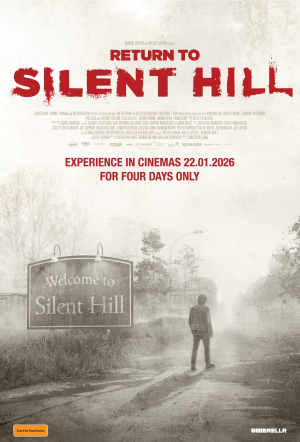
I thought about that last part specifically after watching the recent film adaptation, Return to Silent Hill. At my late-night screening, I caught sight of a cosplayer dressed as Pyramid Head, the game’s most iconic monstrosity. They looked great, had clearly put a lot of effort into the outfit, and I assumed they knew this 25-year-old game inside and out. Could any faithful adaptation really put this super-fan back into that feeling of walking into the unknown?
I doubt it.

Silent Hill 2 (2001)

Return to Silent Hill (2026)
This doesn’t excuse Return to Silent Hill’s many shortcomings which have been well documented by film critics and fuming YouTubers. Soap opera flashbacks, dicey CG work, wobbly performances, that one scene where James (Jeremy Irvine) hides but forgets to turn off his flashlight… there’s a lot to slam.
And yet, it’s not a total write-off. Christophe Gans, director of 2006’s Silent Hill, commits to a dream-logic narrative fitting of the psychological, nightmarish quality the game’s renowned for. Especially in the third act’s descent which dares the audience to interpret the open-ended meanings to its freakish imagery. Unfortunately, those well-versed in the game’s themes and story already boarded up those opened doors inside their brain basement. As for audiences unfamiliar with the franchise, I can only imagine clocked out within the first half hour.

It’s why a faithful remake of Eraserhead or Mulholland Drive could never work (not that anyone ever has, or should, ask for one). Both films come from David Lynch, the great master of freakishly abstract cinema, who I associate closely with Silent Hill 2.
Masahiro Ito, art director on the videogame, cited Lynch’s Lost Highway as early inspiration, though the final product arguably shares more in common with Twin Peaks, which was huge in the development team’s home country of Japan.

And then there were the Welcome to the Third Place ads made by Lynch for Sony’s PS2. They were uncompromisingly true to the auteur’s vision—strange, obscure, freaky, alluring—and alluded to a whole new dimension of experiences people wouldn’t be able to comprehend.
That whole mood didn’t really reflect the overall vibe of the initial PS2 library which contained a lot of fighting games, sports titles, and fantasy RPGs. But then came the strange, obscure, freaky, alluring world of Silent Hill 2—the closest we ever got to being inside The Third Place.
Like Lynch’s work, any Silent Hill 2 imitator must diverge and carve its own path into the unknown. Funnily enough, the recent Silent Hill 2 remake understands this more as a game than Return to Silent Hill does as a movie.