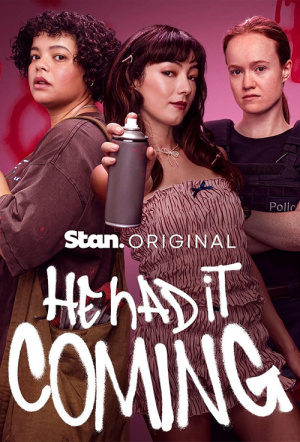
Two uni students’ drunken protest art unintentionally ties them to a murder in Aussie series He Had It Coming.

Busting on the scene with the verve of a gender politics Eddington, Stan Original Aussie series He Had It Coming wastes no time to provoke. We’re barely ten minutes in before being exposed to a suss art history lecturer slack-jawed and gawking at nudes of women painted by Monet and Michelangelo, a footy lad barging into the same class to loudly call his ex a bitch for ghosting him, and an ostentatious feminist activist taking the FTP acronym to the KAM extreme—Kill All Men.
Subtle this is not, and it’s completely by design. By leaning hard into caricatures and generalisations, creators and co-writers Gretel Vella and Craig Anderson use pitch black comedy to poke and prod at how ideals, identity, and justice get contorted in a digital age populated by disingenuous online personalities.
On either ends of the popularity spectrum are Barbara (Natasha Liu Bordizzo), a campus queen with a wealthy online following, and Elise (Lydia West), an open-hearted but lonely British exchange student prone to anxiety-retching. The former aims to be the Doe to her man’s Stag (it’s a social hierarchy thing) while the latter dreams of creating meaningful protest art. Between Barbara’s rage over a recent social shaming and Elise’s artistic drive, this unlikely pair join forces to make a statement aimed at the groin of the patriarchy.
But rather than sit down and put some proper planning into their activist actions, these two dumb-dumbs instead choose to get hammered, vandalise a statue, and snap a photo of themselves doing it. To be fair, they didn’t bank on the castrated body of footy star Scott to turn up the next morning in front of their brand-new Banksy.

Despite Scott being well-known as a perpetual rapist on campus (hence the title), his horrid behaviour’s been excused enough times—“Yes, he was a groper, but only when he’s drunk”—to make the public treat his death like an unprovoked attack against men, sending the university’s young lads into a panicked frenzy. It’s reasonable to be stressed about a murdering dick-apitator being on the loose, but the show’s dark grin emerges when the men’s new fears—walking alone at night, told to carry a useless whistle, taught self-defence when the real problem is men being murdered—are the same fears women have carried for centuries.
Prue (Roxie Mohebbi), meanwhile, is the immediate suspect in this whodunnit case—largely in part for being the most “radical” feminist on campus. She denies doing it but admits she wished she did, loudly and brashly. Any feminism that isn’t maximalist may as well mean nothing to her, which reflects the complex spectrum of identity and power running parallel to the show’s broad-n-black sense of humour.

Prue finds strength in being abrasive and to-the-point about women’s oppression while Elise struggles to muster enough self-esteem to back her creative voice and affecting protest art. Barbara, meanwhile, places her strength in her social circles—circles marinated in misogyny—which generates the kind of inner conflict that sees her reluctantly attend a Pimps and Tarts party in Scott’s honour because “it would be disrespectful for me not to attend.”
And then there’s Detective Shepherd (Liv Hewson), the person who’s perhaps most aware of just how toxic this environment can be for woman on account of her being: a) a woman, b) a campus officer, and c) the only person abused female students can turn to. Hewson plays the character dead serious for good reason; there’s no way to goof up a woman this embedded in a system that consistently and systematically fails women. It’s even harder to help a group, led by Prue, identify her as a symbol of that same machine.

It’s one of the show’s more profound examples of identity and intent smashing into one another, though it finds plenty of humour in that same theme whether it’s protesting dudes who must make it crystal clear that they’re “Men’s Rights Activists, NOT basement-dwelling incels,” or the self-interested female Vice Chancellor (Lisa Kay) who just wants this case to go away because “financially and optically, this is fucking me.”
The final episode makes it crystal clear that the prime motive behind activism isn’t to “find your tribe.” Through Barbara and Elise, we see the importance of opposites uniting for justice, whether that’s drawing attention to the many faults of a society that disadvantages women or the simple pursuit of a serial killer. He Had It Coming may look at contemporary gender politics with a goofy sense of humour that goes devilishly dark at times, but its focus on unity over division ultimately makes it a surprisingly tender-hearted series.