Riz Ahmed, by the mere fact of being British and a man, has at various points been rumoured for the role of James Bond. It’s flattering, I’m sure. But I wonder what it feels like for these actors who, so often against their will (Ahmed, for one, never even auditioned), are being offered up as sacrificial lambs for scrutiny and debate to the country’s unforgiving public. Are they handsome enough? Charismatic enough? British enough?

And for actors of colour like Ahmed, or the handful of actresses dragged into the gender-swap debate, even the faintest whisper of the word Bond will inevitably thrust them into the centre of an all-out culture war. On the one side, there are the simple bigots, delighted at the excuse to hurl abuse under the banner of fidelity. On the other lies the more thoughtful debate around limits of representation, and how much oppressed groups gain from stuffing themselves into boxes constructed for the white, male, cis, straight, imperialist figure, as opposed to crafting stories and characters entirely their own.
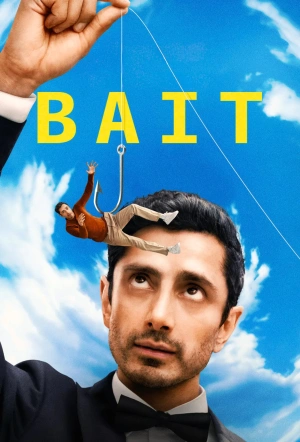
So, what does it mean when the role of a lifetime puts a target on your back? It’s an experience explored in Bait, which was written by Ahmed and features him in the role of Shah Latif, an actor who, despite a couple of buzzy roles under his belt, is deep in debt. When his Bond audition isn’t quite the desired home run, he, in a moment of desperation, flaunts the usual demands for secrecy and ensures he’s photographed by the paparazzi on his way out.
Right on cue, he becomes a topic of national conversation. You can see that little tingle crawl up Shah’s spine. As a kid, he was targeted by Islamophobic abuse at school; as an adult, he’s mistaken for Dev Patel on the street. His inner critic has turned ruthless. And yet he’s come so close to the pinnacle of acceptance that he can practically taste it. The poise of the designer tux. The clipped, martini-smooth delivery. The cool hand on the trigger.
Then comes all the talk. He becomes the victim of a hate crime, which Ahmed mines for dark, surrealist laughs, while his own community starts to question his motives, including his journalist ex-girlfriend Yasmin (Ritu Arya). “Isn’t it more racist to be killing yourself to play a white neocolonial MI6 agent?”, she tells him. “But if I was playing him, he wouldn’t be white, would he?” he replies. The next line is brutal: “Yeah, but you would be.”

Bait knows its audience and speaks to them directly, with little of the dilution that comes from angling for uncomplicated mass appeal. It’s notable how naturally Palestinian solidarity is woven into the narrative, as Shah and his cousin Zulfi (Guz Khan) argue over whether halloumi is a boycott target or not.
It doesn’t fully dissect Bond himself as a cultural force – after all, the franchise was recently acquired by Amazon, and Ahmed needed to seek permission from producer Barbara Broccoli to proceed – but there’s enough viewpoints on the issue included here that the concept never feels shortchanged by the execution. That Bait was produced for a major conglomerate feels less hypocritical than metatextual.
If there’s anything that feels truly at cross purposes, it’s the fact that Ahmed’s vision, understandably, yearns to see Shah as more than a thesis on representation. But the show consists of only six half-hour episodes. And every scene that scratches at Shah’s home life, including his relationship with his other cousin “Q” (Aasiya Sha), and the self-contained episode where he joins Yasmin on the hunt for her stolen phone, feel as if they would have been better placed as a part of larger narrative.
But that’s the curse of Bond for these actors, I guess. Every road leads right back to 007.