Imagine a Studio Ghibli film crossed with The Jetsons—pretty good combo, eh? You’re in the right ballpark for Arco, give or take a few hops across the cosmos. This delightfully bright, time travel-themed family film from France almost literally trips the light fantastic, with lots of rainbow colours, fluffy white skylines, and a plot that joins together two wide-eyed youngsters from different versions of the future: one very, very far ahead, and the other very, very, very far ahead.
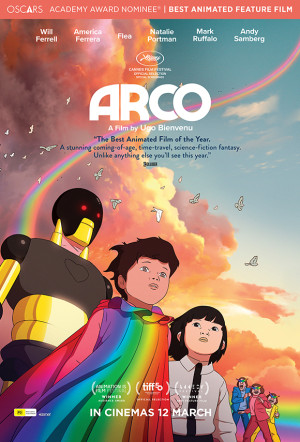
In the latter, it’s 2932 and humans are living co-operatively with robots in sleek cities far above the Earth’s surface, which has been devastated by the climate crisis. Life seems pretty good up here, and there’s even a fun new form of tourism allowing people to whoosh backwards in time to, say, the era of the dinosaurs—from which the family of 10-year-old boy Arco (voiced by Juliano Krue Valdi in the English version, and Oscar Tresanini in the French) have recently returned.
Arco’s older sister brags about how great a time they had, but poor Arco is a couple of years too young to legally time travel. Sneaking out at night, he steals his sister’s time-travelling apparatus—a gemstone and a rainbow-coloured suit, because, shiny!—and attempts to check out those dinos for himself. Instead he flubs his destination and lands in 2075, allowing the storytellers to show us that other version of the future and, more importantly, the other main character: the pensive and inquisitive Iris (Romy Fay in the English version, Margot Ringard Oldra in the French), with whom Arco quickly develops a friendship.
Like the 2932 setting, revealing the details of this world is a process connected to the ways in which characters experience it. World-building here isn’t a matter of exposition but of perspective: the place takes shape through the people inhabiting it and the emotions they carry. What good is a world if there’s nobody to share it with, no emotions to help define it?
It’s clear that Iris is lonely and hungry for human connection, her parents beaming in remotely via holographic projections. She is, however, tended to by a helpful if rather doting robot; looks like we avoided the AI apocalypse. The same cannot be said of the climate crisis: residents are protected by large dome-like spheres that surround buildings, insulating them from extreme weather events.

This gives Arco a smidge of socio-eco commentary, emerging in ways that feel organic to the experience: a natural extension of settings and circumstances. It also enables director Ugo Bienvenu (who also co-wrote the script with Félix de Givry) to conjure a rare vision of both dystopian and utopian future worlds that exist in the same universe, but at different points on the timeline.
It’s sweet to follow Arco and Iris as they hang out and bond, trading insights into their respective worlds—the former, for instance, attempting to teach the latter how to speak the language of birds. We can sense that this will be one of those friendships forever imprinted on each of their psyches but able to last only a limited time—like the relationship between Elliott (Henry Thomas) and the long-necked, walnut-skinned alien from E.T. the Extra-Terrestrial, which explored the melancholic process of saying goodbye.
There’s also the presence of three conspiracy theorists who are after Arco; years ago they saw another rainbow-coloured time traveller but, dismissed as quacks, they long to be vindicated. This allows the film to present characters who are not so much villains as villain-adjacent, adding friction rather than menace, plus a touch of comic relief. Bienvenu doesn’t quite pull this off, creating characters who are not very dramatic and not very funny. But overall Arco is a real treat: a colourful, ideas-rich family film that will leave you feeling emotionally full.