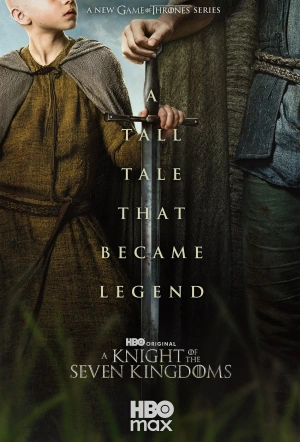
A Knight of the Seven Kingdoms, the latest spinoff in the Game of Thrones franchise, is about a dead man so small in importance that none of the lords he bruised and bloodied his body for even remember his name. Ser Arlan of Pennytree (Danny Webb) left no heirs, no widows; no-one but his former squire Dunk (Peter Claffey), who arrives to participate at a tourney (or tournament) in the town of Ashford. He hopes he can carry on his former mentor’s legacy as a “hedge knight”—a hired sword with no master. Yet, every door is shut on him. No-one recognises the name Pennytree, nor any tale of how he risked his life in battle for them. Somewhere, in a field a few days’s journey away, flesh rots.
A Knight of the Seven Kingdoms: Season 1


The argument has been made, and I’m sure will be made many times again, that Ira Parker and George R. R. Martin’s adaptation of the latter’s Tales of Dunk and Egg novellas is too lightweight and inconsequential for mainstream television. It takes place around a hundred years after the current Targaryen-focused House of the Dragon and a hundred years before Game of Thrones proper, and has no bearing on either. The great houses mentioned—Baratheon, Targaryen, Tyrell—may be familiar to our ears, but there’s no secret Emilia Clarke cameo waiting around the corner.
And why should there be? There’s something quite dispiriting in the idea that our leisure time is now so precious that we must demand maximum utility from the art we consume; that there’s no purpose to it if it doesn’t “advance” a franchise’s interests or educate us on wider lore. Are we losing the ability to simply take pleasure in a good story? A Knight of the Seven Kingdoms may eschew grand schemes and battles, its dragons may all be long gone, yet it boasts two of Westeros’s most charming and loveable protagonists. And that’s more than enough.
Dunk, played by Claffey, an Irish former rugby union player who stands at an impressive 6ft 5in, is all heart and no grace. He’s had rotten luck in this world, so he clings to the memory of a father figure who beat him regularly (though he claims, “never…when I didn’t deserve it”) because he at least spoke of his chivalric ideals in a way that brought some purpose to their rudderless lives.
Dunk’s no Jon Snow. The series ensures we grasp that within minutes, as a flourish of Ramin Djawadi’s Game of Thrones theme cuts abruptly to a scene of projectile shitting—but Dunk is a fundamentally good person in a rotten world. His inability to access the privileged class of herodom is neatly underlined by the fact he can’t even physically pass through a castle doorway without whacking his head. He talks to horses like they’re people, too, which is very endearing.

Pair Dunk with Egg (Dexter Sol Ansell)—the bald little boy he meets at a local tavern who employs himself as Dunk’s new squire, who’s both adorable and eerily wise beyond his years—and you have some real narrative magic on your hands. A Knight of the Seven Kingdoms never unnecessarily meddles the formula in search of scale or length: there are six half-hour episodes and, though we’re introduced to the colourful likes of Daniel Ing’s raucous Ser Lyonel Baratheon and Shaun Thomas’s more humble Raymun Fossoway, we essentially never leave Dunk’s side.
We’re seeing Westeros here through the eyes of a true everyman. He only knows of dragons in puppet form—a spectacle at a post-joust theatrical performance—and fights so desperately and clumsily that the series’s relatively intimate climactic fight still thrills, since director Sarah Adina Smith has us watch it from the point-of-view of a helmet slowly filling up with blood. The series is brutal when it needs to be, but borrows frequently from the modern tradition of eccentric neowesterns, with Dan Romer’s score peppering in the occasional whistling folk tune (and even, surprisingly at one point, a light bit of jazz).
I can’t help but think, in that regard, of Disney+’s treatment of The Mandalorian, and how quickly the show’s original, instantly appealing premise—Pedro Pascal and a small, green alien baby wander the galaxy doing odd jobs—degraded into yet another puzzle piece in the franchise’s grand narrative plans. You’d hope A Knight of the Seven Kingdoms won’t fall into the same trap, considering it’s working off of extant material. Television could really do with the reminder: the worth of a story is not its size.